Instruction:
See Email Prof Smith Tolken 8 Feb 2023
Dear Ernest,
Our telephonic conversation refers.
The DHEP has embarked on the development of a B-Degree in Energy Management in collaboration with CBS and CPUT. One of the information gaps is which qualifications are already offered in this field on both TVET and University level.
A study to map all the qualification has become paramount to:
- Firstly, determine feeder qualifications for this degree (articulation with TVET and NQF Level 5 qualifications and
- secondly, post-graduate qualifications as a further study path for prospective students. I am approaching you as both of you are well-informed of what the DHEP does and aim for.
The purpose of the study will be to
- firstly, pitch the degree on a level where there is a shortage of knowledge in the field and
- secondly, look at gaps in the body of knowledge that may be covered by such a degree. E. g. one of the areas might be regulation of the renewable energy industry – something that has come under our attention.
The information about each of the qualifications should at least (but not exclusively) provide the institution where the qualification is offered, the NQF level, number of credits of the programme, timeframe of qualification (years etc.), the enrolment requirements the articulation with a degree programme and/or post-graduate degree, the typical designation of students obtaining the qualification in the industry and a broad framework of what the content of the programme entails.
DHEP undertakes to provide you with a list of possible sources of information that will be able to assist you in finding the information that we are looking for. If you are interested, I will appreciate it if you can submit a proposal for the task as well as a budget. The work is fairly urgent, and I would like to have at least provisional draft of your report by end of March this year. I will also need to have a preliminary projection of the data by 23 March to present to the premier of the WC.
I will avail myself to have a discussion with you if anything is unclear.
CORE EXTRACT:
The purpose of the study will be to
- firstly, pitch the degree on a level where there is a shortage of knowledge in the field and
- secondly, look at gaps in the body of knowledge that may be covered by such a degree. E. g. one of the areas might be regulation of the renewable energy industry – something that has come under our attention.
COURSE MAPPING:
Definition: A Course Map is a document that shows the connections between the Course Description, Learning Outcomes, and the proposed summative/signature assignments that students will fulfill as evidence of their learning experience.
Course Maps can be constructed in the following formats:
- An outline with bullets for each Learning Outcome with subordinate content to indicate the summative assignment(s), formative assignments, and resources.
- A table in a spreadsheet that aligns each Learning Outcome to rows of proposed assignments, activities, and resources.
- A visualized mind map that shows lines connecting each Learning Outcome to various assignments and resources.
Generally, the faculty expert’s goal is produce a Course Map document that will make sense to the director of the academic program while also serving as a blueprint for developing a more linear design of the course itself (such as a syllabus or mockup).
***************
What Is a Course Map?
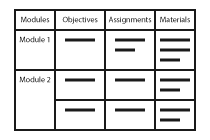
Simply put, a course map is an outline of your course. You may have heard this referred to as curriculum alignment or something similar, but, whatever the case, a course map identifies each of your learning objectives, the assessments that you’ll use to prove that students understand the content, and the instructional materials that students will use to prepare for those assessments. By putting these elements side by side, a course map illustrates what students will do, consume, and accomplish throughout your online course.
*************
HOW TO MAP YOUR COURSE
Follow the steps below to complete your course map.
Click the links for more information.
Modules: Scaffold your Course Learning Outcomes and create a structure by organizing them into manageable units of learning.
Module Learning Outcomes: Identify the specific learning outcomes for each module and note how they target Course Learning Outcomes.
Assessments: Identify the formative assessments and the summative assessments. Determine acceptable evidence of the achieved learning outcome at different levels of mastery.
Activities: Brainstorm the types of activities that will facilitate meaningful engagement, practice, and transfer of learning.
Instruction: Determine the learning materials, resources, and key principles that will equip learners and provide a solid foundation of understanding.